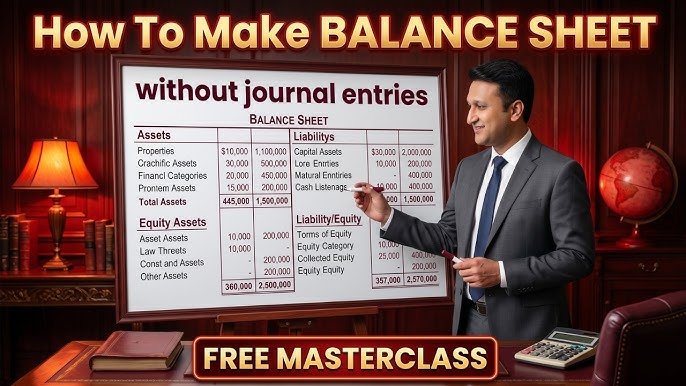
Whenever accounting comes up, the balance sheet is usually the part that scares people the most. But honestly, how to prepare a balance sheet isn’t as hard as it sounds. Once the concept clicks, it’s just a simple format for checking your business’s financial health.
What Is a Balance Sheet
Quick answer: A balance sheet is a financial statement showing a business’s assets, liabilities, and equity at a specific point in time. Its basic formula is: Assets = Liabilities + Equity.
What Are Assets
Assets are things the business owns that hold value. These fall into two categories:
- Current assets – cash, bank balance, inventory, receivables (convertible to cash within a year)
- Fixed assets – property, machinery, equipment (for long-term use)
What Are Liabilities
Liabilities are what the business owes – whether to suppliers, a bank, or anyone else.
These also come in two types:
- Current liabilities – short-term loans, payables due within a year
- Long-term liabilities – bank loans repaid over several years
What Is Equity
Equity is the owner’s share – if you sold off all your assets and paid off every liability, whatever’s left is equity.
[link to related guide on filing GST returns]
Steps to Prepare a Balance Sheet
Let’s walk through this with a simple example – say a small manufacturing unit in Jaipur:
- List out all assets first (cash, inventory, machinery, etc.)
- Then list all liabilities (loans, payables, etc.)
- Calculate owner’s equity (assets minus liabilities)
- Match both sides – assets should always equal liabilities plus equity
Why the Balance Sheet Sometimes Doesn’t Match
This is a common problem for beginners. If your balance sheet isn’t matching, it’s usually because of:
- A transaction that wasn’t recorded
- Depreciation not calculated on assets
- Wrong opening balance entered
- A mistake in double-entry bookkeeping
Balance Sheet vs Profit-Loss Statement
Many people confuse these two. A profit-loss statement shows performance over a period (like a month or year), while a balance sheet shows a business’s position on a specific date – it’s a “snapshot,” not a “movie.”
Should You Use Excel or Software
Starting out, Excel works just fine. But as the business grows, using accounting software like Tally or Zoho Books saves time and cuts down on errors.
FAQs
Q1. How often should I prepare a balance sheet? Ideally monthly for internal review, and annually for official filing purposes.
Q2. Do small businesses need a balance sheet too? Yes, whether your business is small or large, tracking financial health matters.
Q3. What is depreciation and how does it show up on the balance sheet? Depreciation means an asset losing value over time – it’s subtracted from the fixed asset’s value on the balance sheet.
Q4. My balance sheet isn’t matching, what should I do? Recheck every transaction, especially opening balances and depreciation entries.
Q5. Do I need a CA to prepare a balance sheet? Small businesses can prepare a basic one themselves, but a CA’s help ensures accuracy.
Conclusion
Learning how to prepare a balance sheet is a genuinely useful skill for business owners, whether you’re doing it yourself or having a CA handle it. This document tells you how financially healthy your business actually is. It takes some time to understand at first, but once you get the hang of it, it becomes one of your most valuable financial tools.